
Multi-Family DBT for Teens
EBT Collaborative's multi-family DBT program (DBT-A) is a comprehensive adolescent DBT program for teens ages 12 to 18 and their families. The program combines individual therapy, multi-family skills training, phone coaching, and a DBT consultation team to provide structured, evidence-based support.
What Is Multi-Family DBT for Adolescents?
DBT-A is an adaptation of Dialectical Behavior Therapy developed specifically for adolescents and their families. It differs from adult DBT in two important ways: the skills are adapted to be more accessible for teenagers, and parents or caregivers participate in treatment alongside their teen.
The multi-family format means that multiple families attend the skills training group together. Teens and their parents are in the room at the same time, learning the same skills and practicing together. This structure accomplishes something individual treatment alone cannot: it builds a shared language for emotions and conflict within the family system itself.
DBT-A has strong research support for reducing suicidal ideation, self-harm, and hospitalization in adolescents and is considered the standard of care for teens with significant emotion dysregulation.

Who DBT-A Is Designed For
Our teen DBT program is appropriate for adolescents who are struggling with:
Self-harm and non-suicidal self-injury
Suicidal ideation or prior suicide attempts
Borderline Personality Disorder or early BPD features
Explosive or unpredictable emotional reactions
Difficulty maintaining relationships with peers and family
Eating disorders co-occurring with emotion dysregulation
Impulsive or risky behaviors
Chronic depression or anxiety with a strong emotional intensity component
Teens who have not improved with standard weekly therapy are often strong candidates for the more intensive structure of DBT-A.
How the Program Works
Individual Therapy for the Teen
Each adolescent works one-on-one with a DBT-trained therapist every week. Individual sessions focus on the teen's specific treatment targets, using the DBT treatment hierarchy to prioritize behaviors that affect safety first, then behaviors that interfere with therapy, and then quality-of-life goals.
Multi-Family Skills Training Group
The weekly skills group is the cornerstone of the program. Teens and their parents attend together and work through the DBT skill modules: mindfulness, distress tolerance, emotion regulation, and interpersonal effectiveness. Because families are in the room learning together, the skills become part of how the family communicates, not just something the teen practices in isolation.
The group typically meets weekly for approximately six months to complete all four skill modules.
Phone Coaching
Teens and their parents can contact their individual therapist between sessions for coaching during difficult moments. Real-world crises happen between sessions, and coaching provides structured support in the moment. This is one of the features that makes comprehensive DBT more effective than skills-only programs.
Consultation Team
Our clinicians participate in a weekly consultation team to maintain treatment fidelity and support each other in working with high-risk adolescents. This component ensures consistent quality of care across all clients in our program.
The Parent Role in Teen DBT
Parents and caregivers are not bystanders in DBT-A. They are active participants.
Adolescents cannot generalize skills from a therapy session into the family environment without support. If a teen learns to use distress tolerance skills at our office but returns home to an environment that inadvertently reinforces crisis behaviors or emotional escalation, the treatment is working against itself.
DBT-A addresses this directly by coaching parents in the same skills, helping them respond differently to emotional escalation, reduce unintentional reinforcement of problem behaviors, and model the kind of validation that makes skills use possible in the first place.
Teen DBT at EBT Collaborative
Our multi-family DBT program for teens is available through select EBT Collaborative locations, with telehealth options available where appropriate. Because program availability can vary by location, contact our team to learn about current DBT-A options for your family.
To learn more about the clinicians who lead our adolescent program, visit our team page.
Intensive, Evidence-Based Support Is Available for Your Teen
If your adolescent is struggling with self-harm, intense emotions, or repeated crises, our multi-family DBT program may be the right next step. Contact EBT Collaborative to schedule a consultation.
-
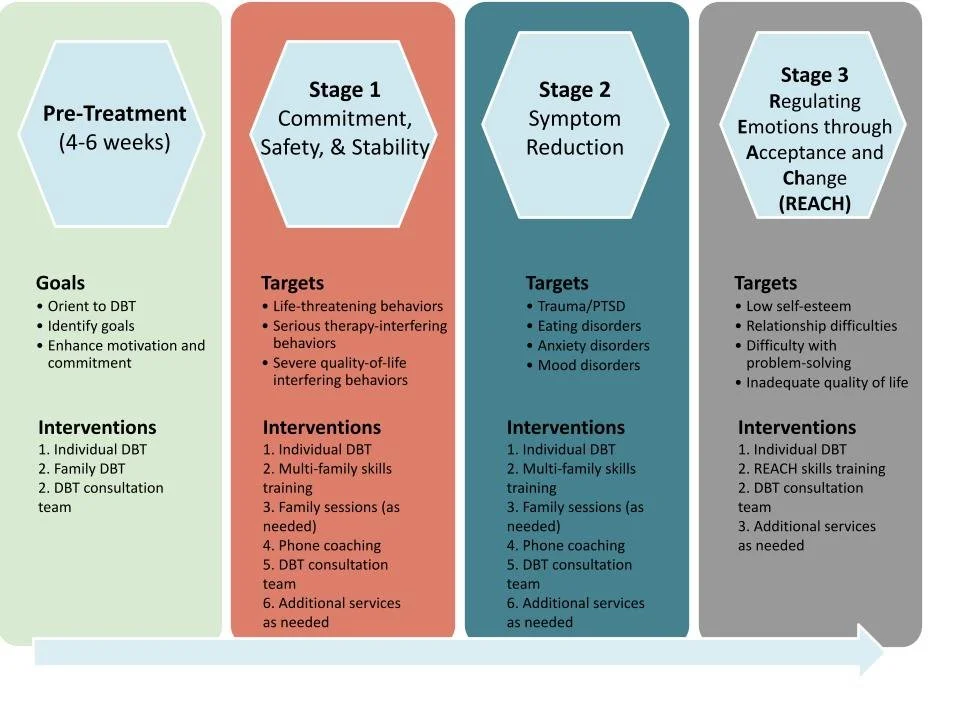
DBT-A is comprised of four modes of treatment that together form the “comprehensive” model: (1) weekly individual therapy for the adolescent (2) phone coaching (3) multi-family skills group (4) MF-DBT consultation team (an essential component of DBT that does not involve client participation). Family therapy sessions, along with ancillary services (e.g. medication management and nutrition services) may also be recommended, based on symptom presentation.
-
MF-DBT occurs over the course of four stages of treatment: pre-treatment, stage 1, stage 2, and stage 3.
Upon beginning stage 1, adolescents and their parents/caregivers will join a 24-week multi-family psychoeducational skills group focused on acquisition of five critical skill sets: Mindfulness, Distress Tolerance, Emotion Regulation, Interpersonal Effectiveness, and Walking the Middle Path.
Adolescent and parent/caregiver participation is an integral component of MF-DBT, and therefore, a requirement for MF-DBT skills class. This type of treatment delivery ensures that both adolescents and their caregivers will learn and behaviorally rehearse skills together, thereby promoting increased connectedness and support in the daily application of DBT strategies.
-
Through knowledge and implementation of DBT skills, adolescents and their families are better equipped to manage crises and communicate effectively, while contending with and tolerating daily life stressors. MF-DBT also assists with problem solving difficult emotions and behaviors, and improves family functioning.